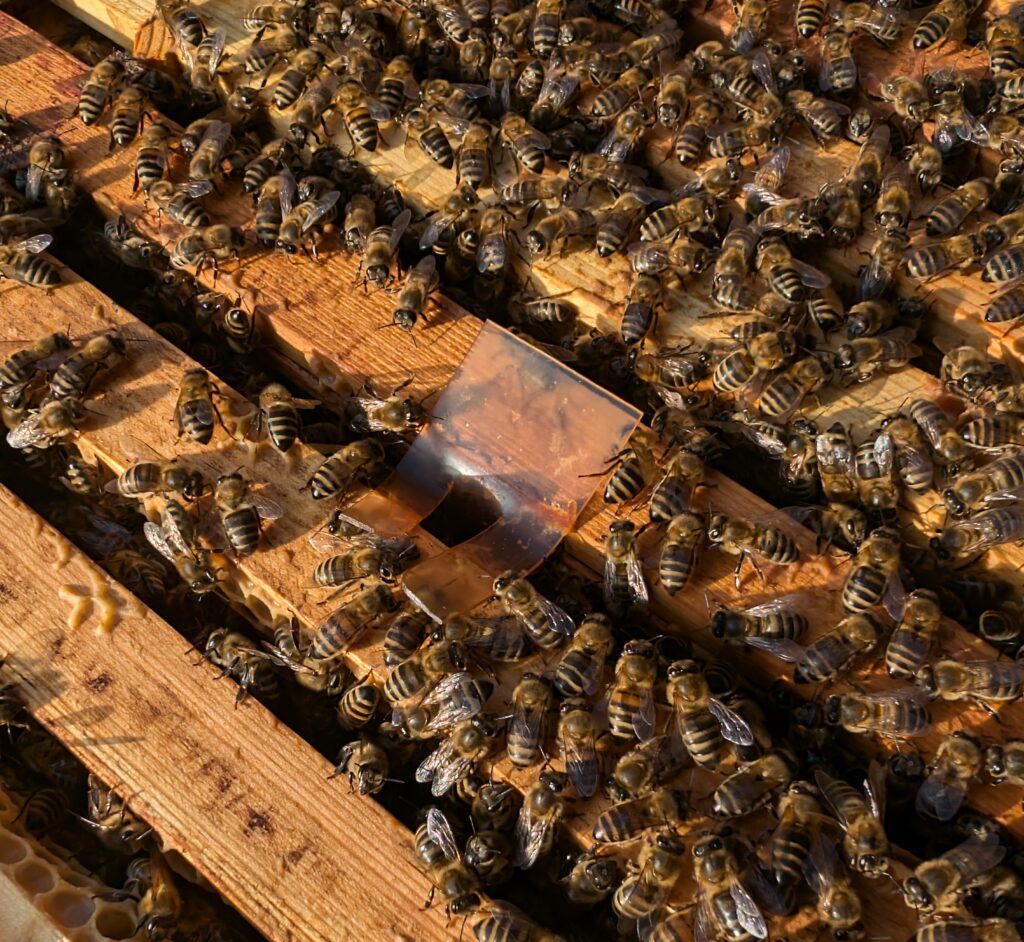
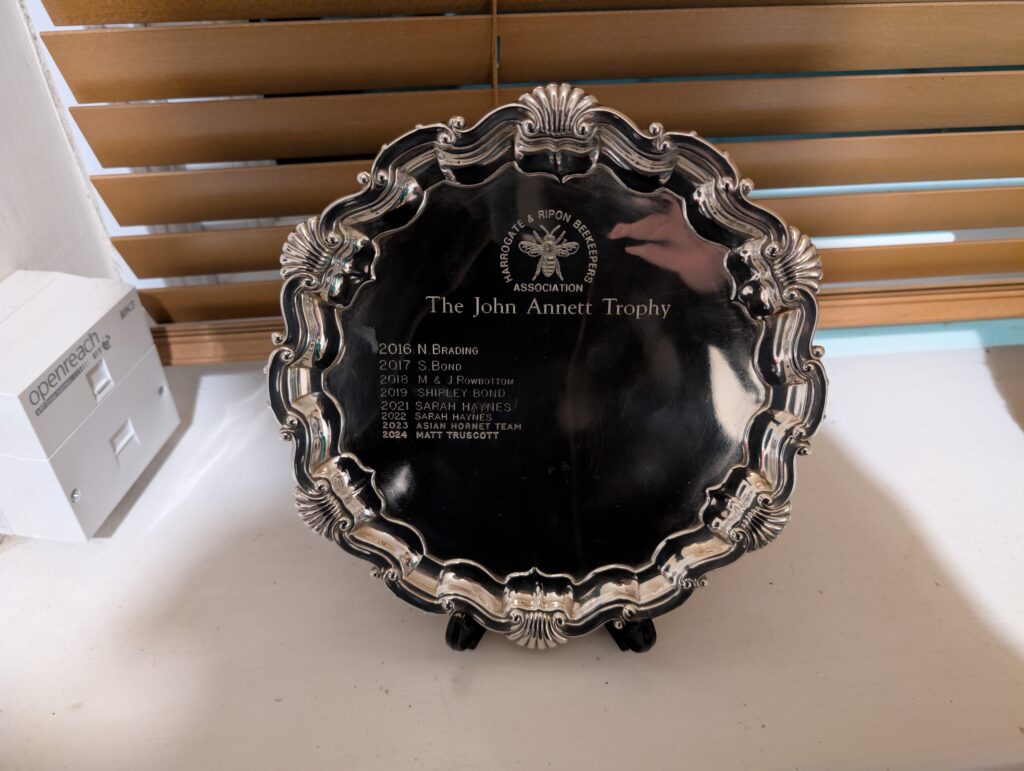
Sunday 3rd August 2025 was a special day: I met the bees!
The Old Church
Who’s there?
| Hive | Lineage | About | Location |
| Hive A | Family 1 | Matt purchased this colony in 2022 as part of the Beginner Beekeeping Course he took through Harrogate & Ripon Beekeepers Association. His beekeeping journey begins! | The Old Church |
| Hive B | Family 1 | In 2023, Matt split colony A but tragically those in Hive B perished. To this day, he isn’t sure what happened to them but the memory of discovering his colony dead still makes him sad. In 2024, colony A had grown so much they decided to swarm, but Matt managed to capture them and they became the new Hive B! | The Old Church |
| Hive D | Family 2 | The bees in Hive C quickly showed signs of being ready to swarm, so Matt spilt the colony to form Hive D. | The Old Church |
| Hive E | Family 1 | Hive E was established in 2025 when the bees in Hive B outgrew their home and needed to be split. | The Old Church |
| Hive F | Family 1 | In 2025, Hive A was once again split and the bees took up residence in Hive F. | The Old Church |
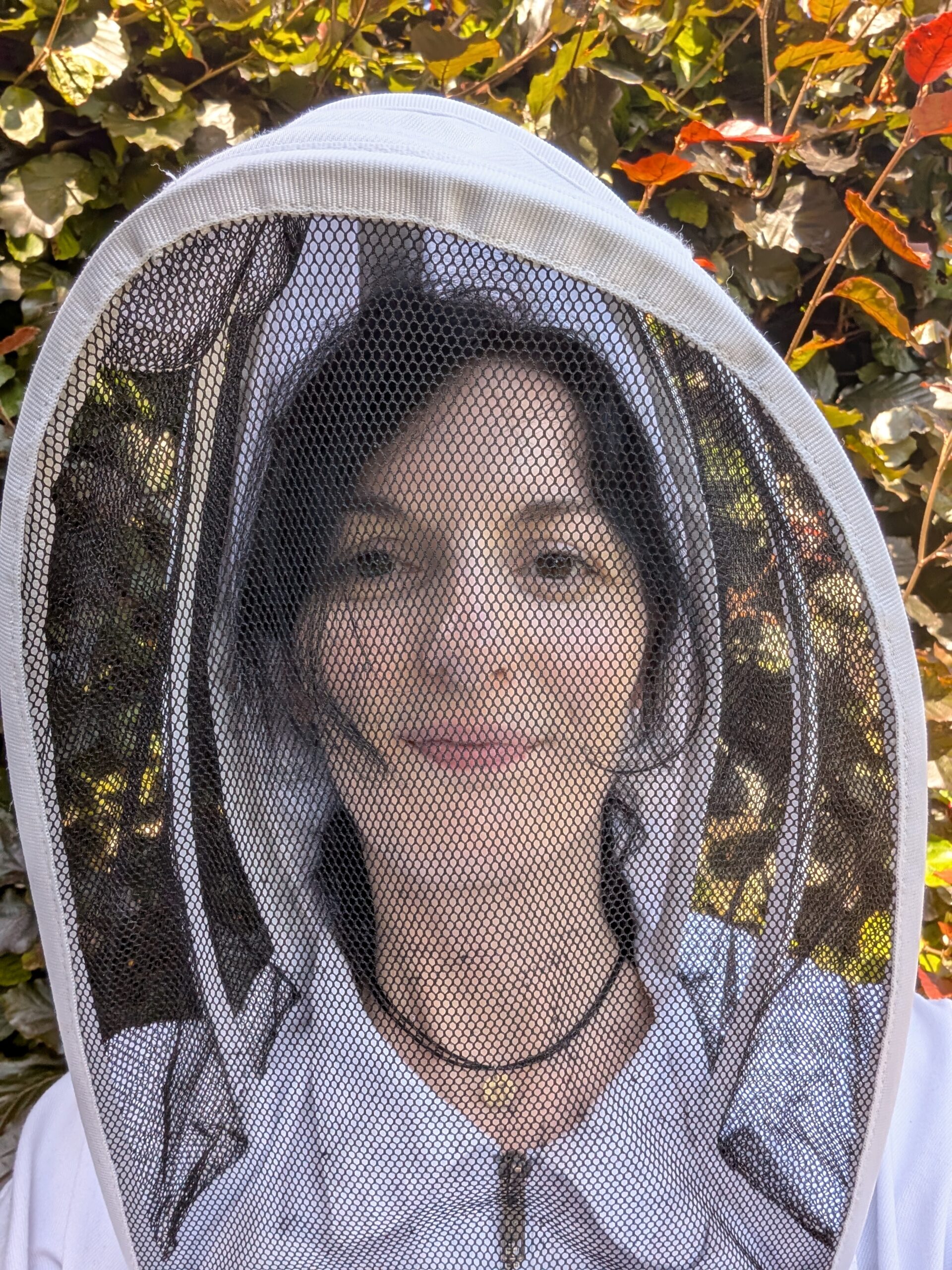
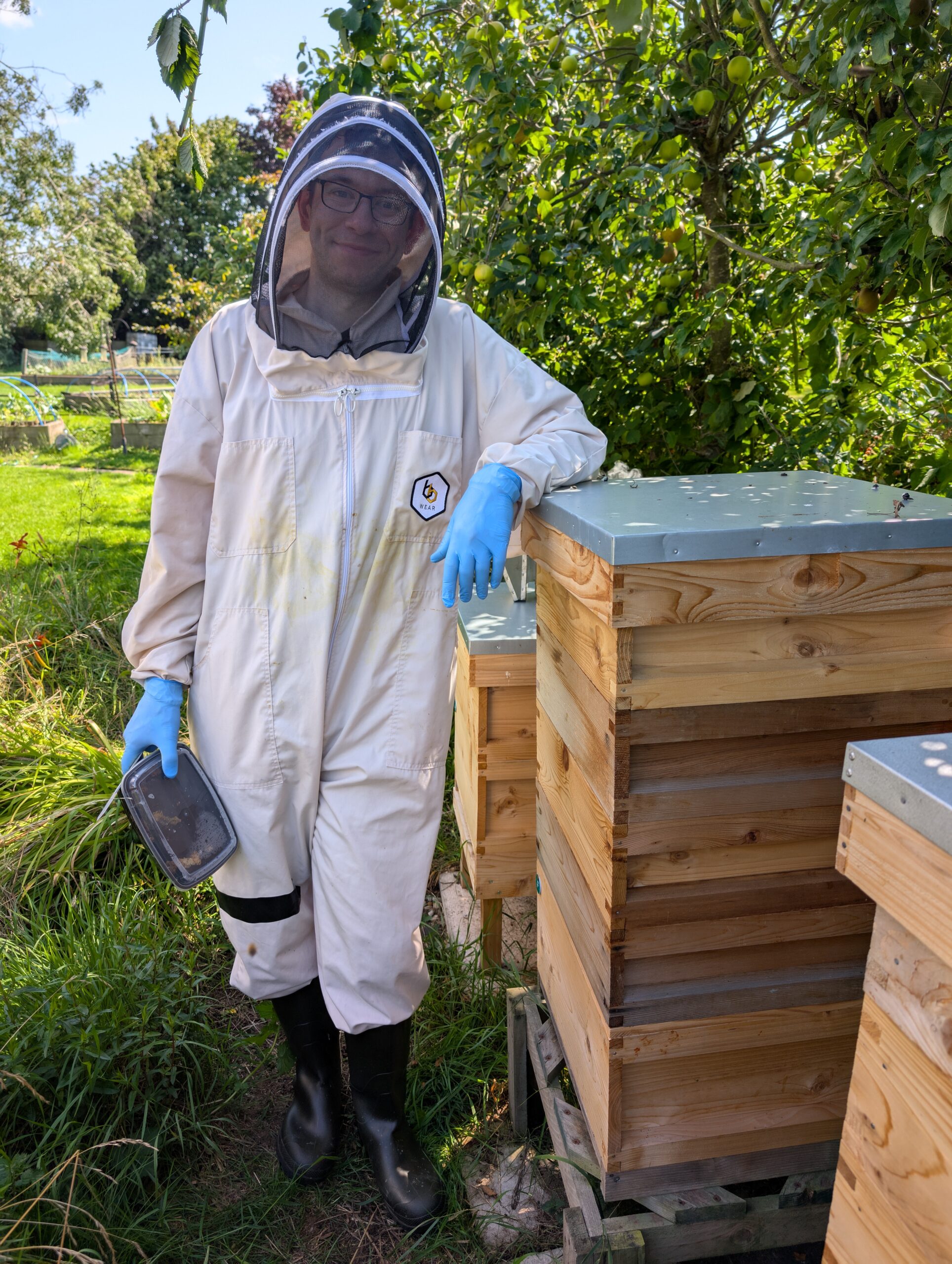
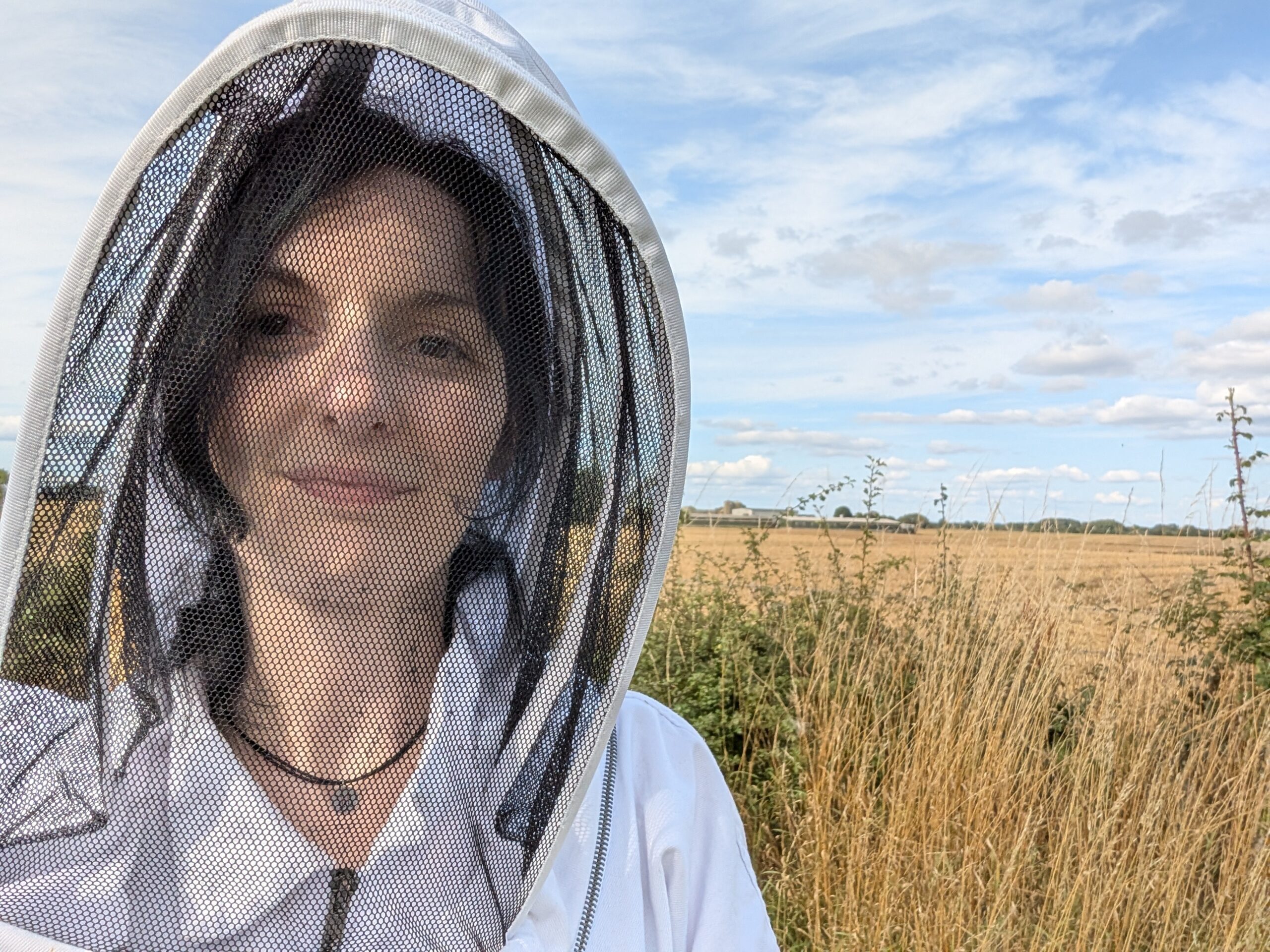
Matt and I arrived at his original apiary site in the early afternoon. After putting on a bee suit for the first time in my life, we entered the garden and I saw the hives with my own eyes!
Stepping closer, the first thing that struck me was the sound. I’d say for approximately half a second, my instinctive reaction was to panic about standing in the middle of so much buzzing. But the sensible part of my brain quickly kicked in to overrule that reaction. I was safe inside my suit, the bees were concentrating on their own work, and it was actually phenomenal.
I was standing amongst families of miraculous insects who are an inspiration to humans and who tend to our beautiful home planet. It was amazing to witness the activity of bees who were heading out to gather supplies, perhaps taking orientation flights, and all the other good stuff they do to create such a productive little society.
Just being there was overwhelming, in a good way. I could have stood there for hours taking in the atmosphere.
Of course, Matt had inspections to complete, so he opened up the first hive!
Hive E:
Wow, my first look inside the home of a family of bees! I was even lucky enough to see the queen! Apparently she’s a bit of a tigress.
The stores inside the cells were prettier than I was expecting, with hexagons of vibrant yellows and deep purples. I asked Matt about this and he told me different pollen comes in different colours and the bees will always keep them organised by type. I’m endlessly in awe of how beautiful and fascinating nature is.
Hive B:
Next, Matt opened up the larger hive beside Hive E. His bees are gentle and calm, so both colonies pretty much just carried on with their tasks while Matt checked on them and I gawked at them.
I found it very cute when the bees were busy doing something inside the comb, and nothing but a little fuzzy honey bee bottom was sticking out!
And I found it incredibly moving when there was nothing but a little honey bee head sticking out of the comb. I saw a bee birth! I said “Welcome to the world,” to the brand new little worker emerging from her cell.
Hive A:
Unlike Hives E and B, this colony was a bit feisty and gave Matt some sass when he opened up their hive. The reason for their attitude was probably the puzzling situation they’re in…
We had a thorough look for the queen but didn’t manage to find her. It’s possible we missed her, but we also kept our eyes open for signs of laying and there were none. This strongly suggests there was no queen in this hive.
However, the workers hadn’t put up any emergency queen cells. When a colony is without a queen, it means trouble, so the workers will act quickly to coronate a new queen. So why hadn’t they?
What’s going on? Was there a queen present or not? Matt was concerned but he decided to leave them alone a little longer before intervening.
After all, maybe the queen was out with the boys when we visited, getting ready to lay like a champion the moment she got home!
Hive F:
The home of Matt’s favourite queen! I was able to meet the exalted royal who has an exceptional passion for laying eggs and surrounding herself with thousands of delightful daughters.
Hive D:
Matt decided it was best to leave this propolis-sealed hive closed. They’re a stickier-than-average colony who get grumpy when Matt unglues their house.
So, that was it. Matt had done all he needed to do and I’d finally visited the bees at Matt’s original apiary site. It was time to set off for Windmill Hill!
Windmill Hill
Who’s there?
| Hive | Lineage | About | Location |
| Hive C | Family 2 | In 2025, Matt purchased a family of bees from a beekeeper who developed a bee sting allergy. | Windmill Hill |
| Hive G | Family 3 | Hive G is a colony of new bees that Matt caught when a beekeeping friend’s bees swarmed in 2025. | Windmill Hill |
| Hive H | Family 4 | Hive H joined Actual Honey after Matt was in the right place at the right time and caught a swarm of new bees in June 2025. | Windmill Hill |
| Hive I | Family 2 | Hive I began in 2025 as a nucleus colony comprised of bees from Hive C. | Windmill Hill |
Hive G:
Hive G was first and I noticed that their temperament was different. They seemed more stressed than the colonies at The Old Church. Why was that? Windmill Hill is a gorgeous site but it’s waspy. Last month, in Matt’s Diary: July 2025, I discussed how Hive J at Windmill Hill was lost to the wasps.
Hive G was still around and surviving but I saw wasps fighting the bees and wasps sneaking into the hive and wasps sticking their faces into the honey stores. Wasps, wasps, wasps! As a relatively small colony, it was taking vital time and energy from the bees to deal with the wasps when what they needed to spend their time and energy on was building their numbers and their food reserves to prepare for the looming colder months.
It certainly can’t have helped that the entrance reducer Matt fitted to help the bees keep out intruders had come loose! He put that back straight away, but he’s also planning to give them additional support. He’s considering donating brood from another colony to boost their numbers, and he might move them into a nucleus hive over the winter.
Hive I:
Speaking of nucleus hives, family I moved house during my visit! They’d been living in a nucleus box and Matt suspected it would be time for them to move into a full-sized hive. When Matt picked them up, their heavy weight confirmed that they were definitely ready for a bigger house.
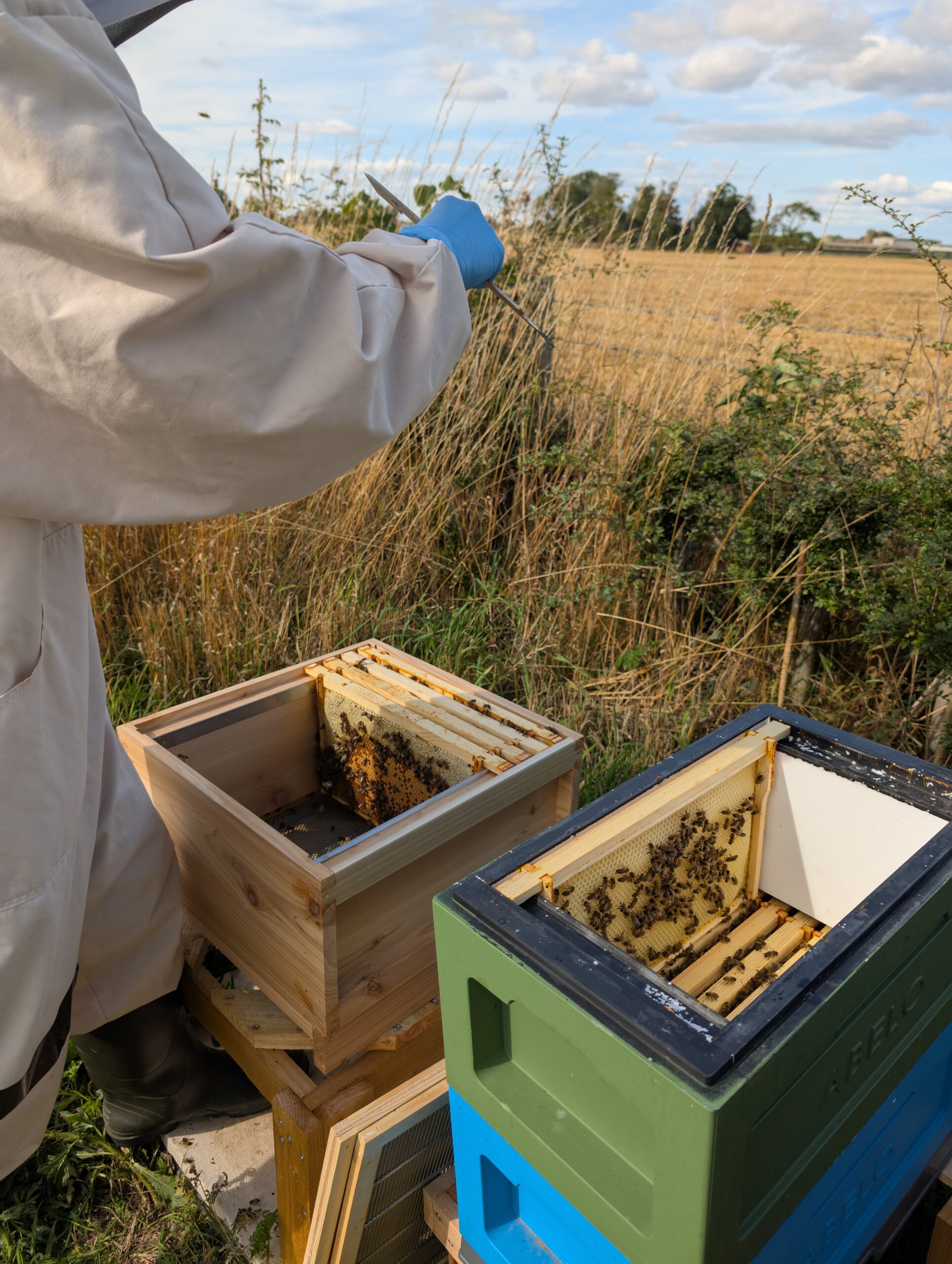
Matt told me that bees remember not only the location of their home but also the colour. The new hive is in the same spot as the old one but it’s now a natural wooden colour instead of bright blue, so retuning workers probably had a moment of asking themselves “Where did my nice blue house go?!”.
Hive H:
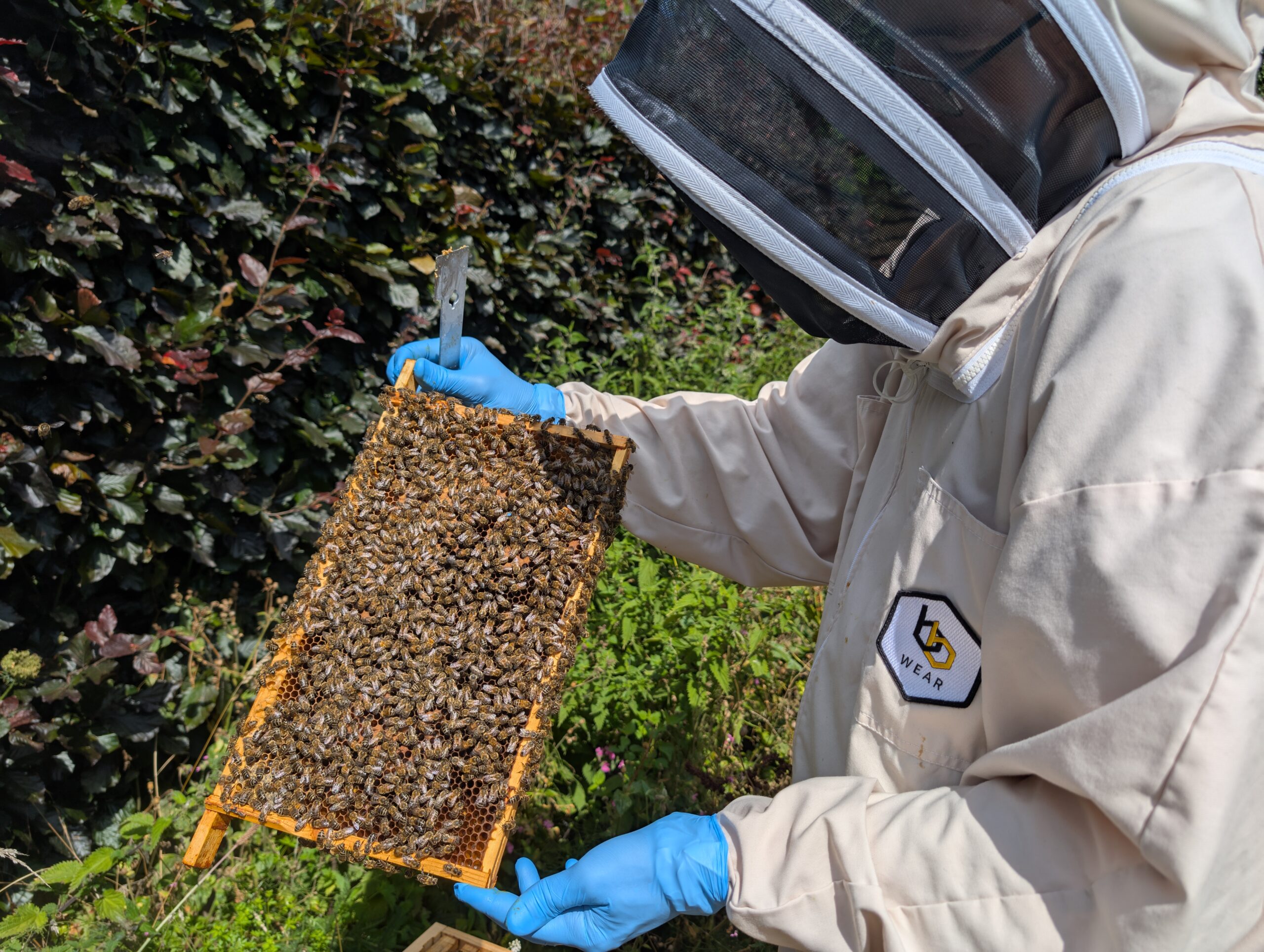
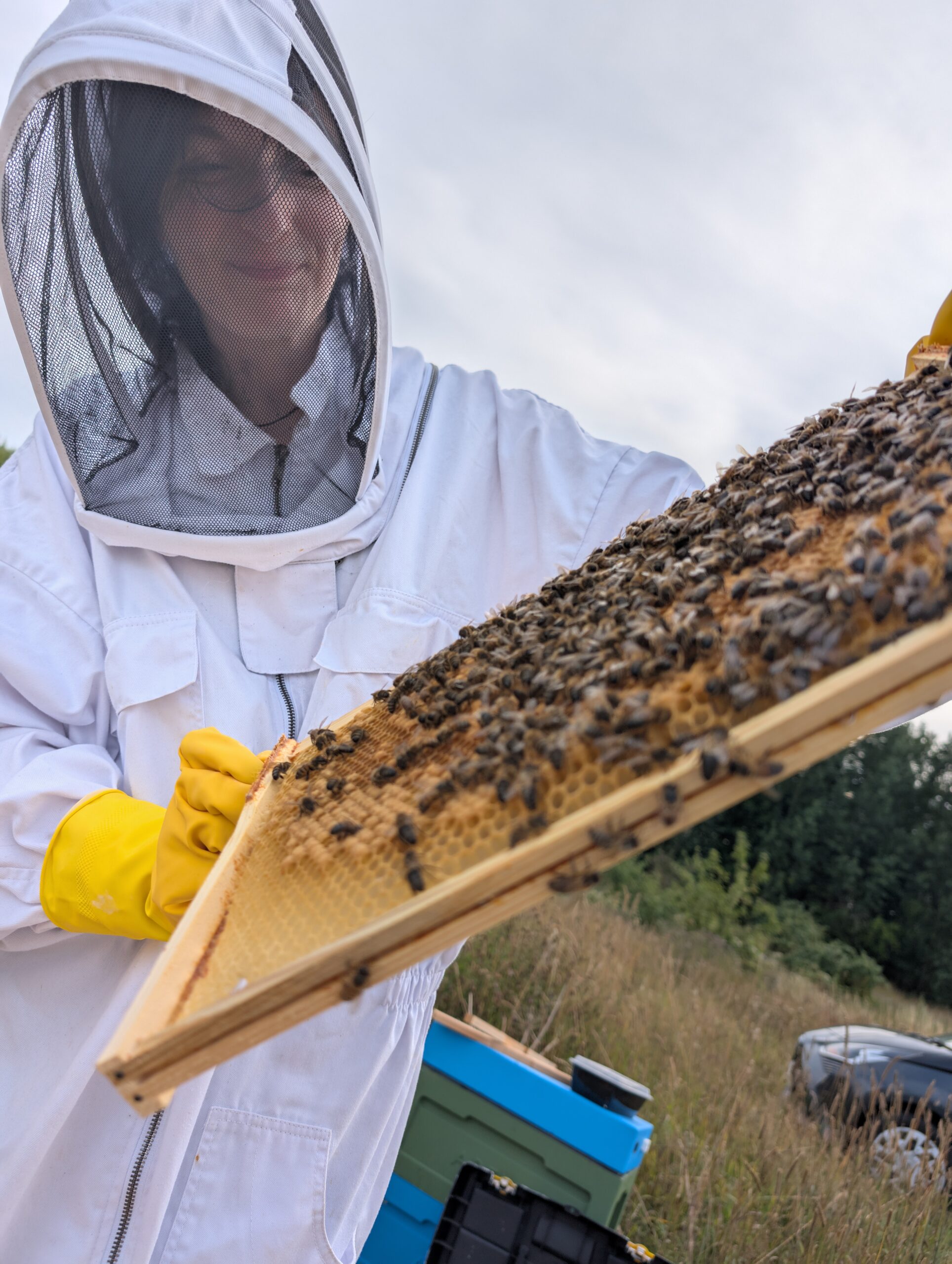
I performed an inspection! Sort of. Matt had to be the brains of the operation and actually check what was happening on each frame. I’m not a beekeeper. But I separated the propolis-coated boards using a hive tool, lifted up each frame and had a look at both sides, and put them all back. And I managed to do it without getting stung, squashing any of the ladies, or even making them angry. That’s not bad! I did it at tortoise speed, but it’s not like I wanted to rush. I wasn’t there to be efficient; I was there to take it all in.
Hive C:
As the largest colony at the site, Matt wasn’t too worried about them. He opened up the hive briefly to check whether they needed more space. Since they didn’t, we left them be.
What an amazing experience it was to meet all of Matt’s bees. Thank you, Matt!